Monday, 3 March 2014
Microchimerism, or how my genes are spreading even further than I'd anticipated...
As an active biological researcher, I'm often amazed at just how impressive nature is, but we discover cool things all the time so I don't often get that "wow" factor any more. However, I recently learned about a phenomenon that actually completely blew my mind: microchimerism. For reasons that are obvious to most of you by now, I've been taking more of an interest in developmental biology in recent weeks. I work in a developmental neuroscience lab but my focus was widened somewhat from interneurons in the hippocampus to how a little human is actually made. Before I explain microchimerism, we need a quick embryology primer for those few friends I have who didn't do a biology degree...
Most people know the basics: sperm meets egg, buys it a few drinks, they sneak off somewhere quiet, fuse their pronuclei (the half-genome that each of them brings to the party), and create a stem cell. This stem cell is pluripotent, meaning that it can form any type of tissue. The cell begins to divide and multiply and, before you can have a panic attack after peeing on a little stick that changes your life forever (*), you have a little ball of cells that have burrowed their way into mummy's uterus and are marching towards the path of becoming a living creature. As the ball of cells gets bigger, some of the cells start to differentiate to form specific lineages of cells that will become brain cells, immune cells, liver cells, etc. The early stem cells can form any type of tissue but you get more specialised stem cells that can form a subset of tissues and these can persist into adulthood: new brain cells are created from adult stem cells that migrate into your hippocampus where they form dentate granule cells (kind of important for memory and learning), and other adult stem cells in your bone marrow give rise to, um, immune cells and other stuff I know nothing about (hey, I'm a brain guy...).
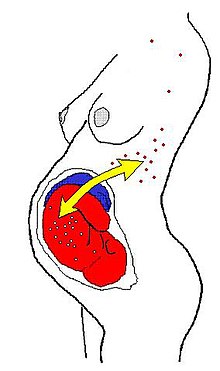
With me so far? Okay, let's explain what microchimerism is and why it's so mind-bogglingly awesome. Well, it turns out that some of those fetal stem cells will go on a jolly and cross the placenta into the mother's body. This in itself isn't so unexpected - there are lots of diagnostic tests where medically-inclinded folks measure fetal DNA from the mother's blood. But what is insane is that these fetal stem cells not only enter the mother's body but migrate to random tissues where they establish permanent cell lines and integrate into the mother's organs. Crazy, eh? The Wikipedia page on microchimerism has this detailed and highly technical diagram:
So a few fetal cells make it to the mother's body and don't get eliminated by the immune system. So what, eh? They can't do anything useful, can they? Actually, they can. This study carried out in rats found that, when experimenters damaged the heart of the rat mother and subsequently got her pregnant, stem cells from the fetuses entered the mother's heart and actually repaired some of the damage. In their introduction, the authors of this study note that their motivation was the observation that, in humans, male cells had been observed in the hearts of mothers with cardiomyopathy (aka 'a dodgy ticker').
Another study (in mice) found that, using green fluorescent cells, they could detect fetal cells in the brains of the mousey mother. The really cool thing is that they found more fetal cells 4 weeks after birth than they did at the time of delivery, implying that the fetal cells had established permanent populations in the brain.
Fetal-maternal microchimerism has been known to occur in most mammals for quite some time. Is there any evidence for it in humans? Well, this PLoS study from 2012 found evidence of male DNA in multiple brain regions of 63% of female autopsied brains, all of whom had had male offspring. What is really interesting is that those women who suffered from Alzheimer's disease were significantly LESS likely to harbour male DNA. Obviously, this doesn't imply that the fetal cells were neuroprotective, but it does raise interesting questions. As an aside, this phenomenon also occurs with female fetuses, but it's much easier to detect male DNA in a female brain, which is why most studies focus on this. The pretty picture at the start of this post comes from this review article, showing male cells detected in a female liver.
If you're more interested in this (and who wouldn't be!?), it's worth looking at these non-specialist articles in The Scientist or Scientific American to find out more than the brief foray that I've made into the subject here.
Most of you know that my lovely wife Dom is a big fan of cake and sleeping. But since she's been pregnant with the twingers, her sweet tooth has been replaced with a craving for bread, cheese and beef jerky. Instead of sleeping in until 10am, she wakes up at 5, ready to eat all the food in the world. We like to joke that this is due to my genes being expressed in her brain, via our future progeny. If she starts making dirty jokes and chasing deer in our local park, we might start to believe this...
Last word? Microchimerism is pretty bloody amazing. And... look what I did (**):
(*) or at least seeing the stick after someone else pee'd on it...
(**) my wife may have done some of the hard work too...
Monday, 20 January 2014
Paying the bills
Happy New Year. Just a quick blog post today.
Most people by now are aware that Scotland is having a referendum on September 18th 2014 to decide whether or not she wants to leave the United Kingdom and become a separate country. Technically, Scotland wouldn't actually leave the UK because this country was created in 1707 when Scottish and English parliaments both passed Acts of Union dissolving their respective parliaments and forming a Parliament of Great Britian, based in Westminster (I'm trusting Wikipedia on this), so repealing the Act of Union would re-establish both Scotland and England as separate countries. I think. I'm not a lawyer. And I wonder what this would mean for Wales and Northern Ireland - would they become English colonies? I just read that Wales formally entered a Union with England a few hundred years after the English conquest.
Anyway, sorry, I'm havering. Technicalities of what to call the new countries is not what I want to talk about. During the independence debate, the Scottish Government has been declaring that all will be easy and sunny in a new Scotland, whilst the no campaign has been focusing on trying to terrorise the Scottish people into being too scared to quit the union. The last couple of years have been filled with scare stories from the UK government and "independent" think-tanks, detailing how much poorer Scotland would be after independence.
As I'm a scientist and like to play with numbers and spreadsheets (hey, everyone needs a hobby!), I decided to trawl through some of the media statements and reports by people like the UK Treasury, the Institute for Fiscal Studies, etc, and added up all their claims of how much independence will cost Scotland. Caveats time: it's a public holiday and I'm going to make a cake soon for Dom, so I only spent 20 minutes Googling and skimming media reports. Therefore the true total cost of Project Fear could be significantly higher. However, everything here is from an attributable comment made in a mainstream media outlet (BBC, Guardian, Scotsman but not the Daily Mail) or in a published report or policy document. Wanna see my data?
Most people by now are aware that Scotland is having a referendum on September 18th 2014 to decide whether or not she wants to leave the United Kingdom and become a separate country. Technically, Scotland wouldn't actually leave the UK because this country was created in 1707 when Scottish and English parliaments both passed Acts of Union dissolving their respective parliaments and forming a Parliament of Great Britian, based in Westminster (I'm trusting Wikipedia on this), so repealing the Act of Union would re-establish both Scotland and England as separate countries. I think. I'm not a lawyer. And I wonder what this would mean for Wales and Northern Ireland - would they become English colonies? I just read that Wales formally entered a Union with England a few hundred years after the English conquest.
Anyway, sorry, I'm havering. Technicalities of what to call the new countries is not what I want to talk about. During the independence debate, the Scottish Government has been declaring that all will be easy and sunny in a new Scotland, whilst the no campaign has been focusing on trying to terrorise the Scottish people into being too scared to quit the union. The last couple of years have been filled with scare stories from the UK government and "independent" think-tanks, detailing how much poorer Scotland would be after independence.
As I'm a scientist and like to play with numbers and spreadsheets (hey, everyone needs a hobby!), I decided to trawl through some of the media statements and reports by people like the UK Treasury, the Institute for Fiscal Studies, etc, and added up all their claims of how much independence will cost Scotland. Caveats time: it's a public holiday and I'm going to make a cake soon for Dom, so I only spent 20 minutes Googling and skimming media reports. Therefore the true total cost of Project Fear could be significantly higher. However, everything here is from an attributable comment made in a mainstream media outlet (BBC, Guardian, Scotsman but not the Daily Mail) or in a published report or policy document. Wanna see my data?
| Who | What | When | How much? |
| Hague & Alexander | Extra EU contributions | 18-Jan-14 | £3,800,000,000 |
| Danny Alexander | Chilcare costs | 17-Dec-13 | £1,640,000,000 |
| IFS / Alexander | Aging population and reduced oil revenue | 26-Nov-13 | £3,000,000,000 |
| IFS | Reducing debt to 40% GDP | 18-Nov-13 | £6,000,000,000 |
| IFS | Matching UK spending cuts to 2016 | 29-Oct-13 | £2,500,000,000 |
| Alistair Darling | Extra borrowing costs for Scottish Government | 27-Nov-13 | £9,000,000,000 |
| Philip Hammond | Loss of defence spending to shipbuilding | 08-Oct-13 | £1,800,000,000 |
| Scottish Global Forum | Running a new military | 13-Nov-13 | £2,500,000,000 |
| John Swinney | Extra costs of collecting taxes | leaked paper | £312,500,000 |
| Total ANNUAL costs | £30,552,500,000 |
In graphical form (because everyone loves graphs):
Disclaimer: I would never use such garish colours in a scientific publication, so this is the only chance I get to make hideously-coloured, non-colour-blind-friendly graphs. Don't judge me.
These data do not take into account any start-up costs for establishing new embassies, building a new military, etc. Indeed, Rory Stewart, Tory MP and former Foreign Office diplomat, claimed that setting up secure communications systems for embassies would alone cost "billions'.
Obviously, no-one from the No Campaign has tried to claim that being an independent country would cost Scotland more than £30bn a year extra, especially given that the annual budget for the Scottish Government is £28.6bn. But if you tally up even a small sample of the claims being made by Better Together, then this is the number you get at. While each scare story in the media may sound plausible on its own, adding it all together demonstrates just how ridiculous Project Fear is getting.
Saturday, 23 November 2013
Generally Recognised as Safe
Today, I want to talk about food additives. That evil institution despised by crazy UKIP and an increasing number of 'mainstream' conservatives in the UK, the European Union, has very explicit rules stating what can and cannot be added to foods. I'm talking about things like artificial preservatives, colourings, flavourings, etc. While some on the right decry the EU as being a source of unnecessary bureaucracy, designed to stifle business and create jobs for overpaid paper-pushers, these rules can occasionally be rather helpful: to introduce a new additive to the European food chain, it has to go through rather rigorous, long-term safety assessments. This seems pretty reasonable, and I assumed that similar standards were applied here in the US, especially given the highly litigious nature of American society.
A few months ago, I read an opinion piece in Nature magazine (as one does) talking about US food additives regulation. It turns out that, to use an additive in the US, FDA (Food and Drug Administration) rules say that if it is Generally Recognised as Safe (GRAS), it is does not need to be approved by the FDA. According to Wikipedia, the source of all human knowledge:
The substance must be shown to be "generally recognized" as safe under the conditions of its intended use. The proponent of the exemption has the burden of proving that the use of the substance is "generally recognized" as safe. To establish such recognition, the proponent must show that there is a consensus of expert opinion regarding the safety of the use of the substance
Which seems fair enough. However, the Nature news piece (which I thoroughly recommend you read) pointed out some flaws in the system: the manufacturer of the additive is itself responsible for assessing whether a substance qualifies as GRAS after which is it requested (but not legally required) to notify the FDA. There are no data describing how much companies actually comply with these regulations, but the FDA found in 2010 that 4 out of 4 energy drink manufacturers that it inspected had not actually carried out the required checks. Yikes!
A study published in December last year found some startling results:
- Fewer that 38% of GRAS claims were backed up by toxicology studies in animals.
- 80% of additives intentionally added to food lacked information on what the safe levels were
- 93% of additives had no data showing reproductive or developmental toxicity.
The same authors reported in another study that, although GRAS assessments should be made independently to avoid conflicts of interest, none in fact are. Of the assessments the authors examined, 22.4% had been carried out by an employee of the manufacturer, 13.3% were carried out by an employee of a consulting firm selected by the manufacturer, and 64.3% were carried out by an expert panel appointed either by a consultancy firm or the manufacturer. Rather chilling reading!
What does this mean? Well, it explains the discrepancies found between the same foods sold in the US and the EU. Skittles sold in the UK are coloured with natural colourings because the dyes used in the US version are mostly banned in the EU because they cause behavioural deficits in children.
One more reason to reduce the amount of processed food we eat, I guess... (dirty processed food such as 7-11 hot dogs, consumed whilst drunk, don't count!) I'm not arguing here that all food additives in the US are dangerous because that would be unscientific: in most cases, there are no data to support the assertion that they are either good or bad. They're probably not deadly because someone would have noticed by now... in fact, they're generally recognised as safe.
Sunday, 10 November 2013
Oh, Canada.
*Updated: I found this article on a Canadian academic website that explains some of the Harper attacks on science with more eloquence and detail than I can muster. Recommended reading for Canadians and non-Canadians alike*
One of the running jokes for liberal Americans is that if the Republicans / Conservatives win an election, they are going to move to Canada. Canada being that lovely, fluffy, kind country to the north of the US that is known for being liberally minded, environmentally aware, having sensible gun-control laws, universal health care, and generally just being a progressive, socialist, European-flavoured version of the US. They even correctly spell many words, such as flavour, although they do share the US obsession with the letter "Z" (e.g. bastardized vs bastardised). But at least they pronounce it "zed" and not "zee".
Unknown to most people, in the last 5 years Canada has been lurching horribly to the right under the leadership of the Conservative Prime Minister, Stephen Harper (not to be confused with Steve Harper, the former Newcastle United goalkeeper). The first time that I heard of Stephen Harper was on my first visit to Canada, when there was a furore over the fact that he prematurely dissolved parliament for the holidays to avoid a vote of no-confidence that would have brought his government down. Even then, the signs were clear that this guy was a bit of an arsehole but, at that time, his party didn't have an overall majority in the Canadian parliament so the damage he could do to the country was limited.
All of this changed in 2011 when Harper won an overall majority in the Canadian parliament, allowing him free reign to start undoing all the things that have made Canada great. I would need several blog posts to go through the terribleness of the Harper regime in full detail, so I'll stick to just the highlights from his assault on the environment and scientific research. One of the first things that he did with his overall majority was to withdraw from the Kyoto protocol, which pretty much sets the scene.
Every year in Canada and the UK, the government brings a budget bill to parliament for approval. Unlike the US, where failing to pass a budget shuts down the government, voting down a government budget bill in Canada or the UK is considered a vote of no-confidence in the government which, by convention, means that a general election has to take place to form a new government. This means that voting against the budget is very much a nuclear option that no politician will have the stomach for.
Harper has exploited this by introducing omnibus budget bills spanning several hundred pages that pack a myriad of law changes spanning everything from environmental legislation through to rights of aboriginal peoples. Last year, he used these bills to strip First Nations tribes of rights allowing them to defend and benefit from resources in their territory. He also used the bills to repeal environmental protection laws such as abolishing the Canadian Environmental Assessment Act, removing the oversight of regulatory bodies on major projects and giving the final say to parliament, allowing the National Energy Board to grant permits for development even when they will threaten endangered species, and many more things. Click on some of the links I've provided, as I'm barely scratching the surface - he's also cutting funding for the arts, removing legal oversight of the security services, etc...
He removed $31b from health care and weakened food and drug regulations, including giving the Health Minister the right to exempt products from legal oversight at will and removing the Canadian Food Inspection Agency from government oversight. Harper has also been doing terrible things to the Fisheries Act including removing habitat protections, reducing the law to only cover fish of "economic interest" and any development that crosses a river, seabed or whatever can only be halted if it will actually cause harm to those fish that are of economic or sporting value. Oh dear.
Harper is a conservative, big business, big oil kind of guy. Most of his policies are aimed at "cutting red-tape" and making it easier to exploit oil resources, but he claims to be trying to save money. I wonder how much of the money he is saving (actually, I know - $65,000) has gone towards plastering Washington, DC with Canadian government-sponsored adverts supporting the Keystone XL pipeline - something so environmentally-damaging that even the US thought that it was going too far.
Perhaps the most disturbing aspect of the Harper regime is its assault on science and the gagging of Canadian government-funded scientists. Harper has introduced rules that prevent any government scientist from talking to the media about their research; when they can speak, they are only allowed to answer questions pre-vetted by the government and in some cases, can only give interviews in the presence of a government minder. All very dark and Orwellian. The international science community is taking notes of this, with Nature running a series of damning news articles and editorials. Canadian scientists are still protesting against this, but this government is not for turning.
It gets worse. Last year, the Canadian government announced that it was cutting funding to the ELA, the Experimental Lakes Area, a 61-year old scientific experiment that has a closed lake system which has allowed hugely important research to take place. Science from the ELA has proven that fertiliser use causes algal blooms, demonstrated how methyl mercury accumulates in fish and goes up the food chain, revealed the mechanisms of acid rain, documented greenhouse gas release from hydroelectric reservoirs and demonstrated how oestrogen in contraceptive pills feminises male fish. The lakes would already have been closed if it wasn't for the campaign of Diane Orihel, who was doing her PhD at the time and managed to make lots of noise and find some alternative funding streams to support the ELA. Harper has also slashed funding for environmental research in his 2012 omnibus bill and has cut funding for basic research in favour of that for applied science.
It gets even worse. This year, the Canadian Government massively changed the remit of the National Research Council, the main funding body for building scientific infrastructre, demanding that the agency only fund projects that are useful for industry. The NRC has cut its priority areas to just five: health costs, manufacturing, community infrastructure, security, and natural resources and the environment. The Harper government has been truly awful for Canadian science.
So why do I care, or bring this up? Well, I'm quite fond of Canada for a start. Given that my wife is Canadian, we have a vested interest in her country not going to ruin while we're living abroad. Once we've finished playing here in the US, we will need to choose a country to settle in and raise our little ginger babies.
Dom does environmental research so it's becoming increasingly clear that her type are not welcome in Canada. I research basic neurophysiology so, while my research is important, it's not going to immediately lead to breakthroughs in disease or produce something that is readily monetisable. That's not how science works. While I often talk about what I see as flaws in the US, one advantage that America has is that it understands the importance of funding basic research both to produce new solutions to environmental and health problems, as well as helping to drive a knowledge-based economy. George Osbourne, take note.
Ironically, given how Canada has changed under the Harper regime, it is the Republicans in the US who should be threatening to move to Canada: Harper is trying his hardest to make Canada a place where they would feel at home...
Canada, sort your shit out!
Monday, 28 October 2013
Half-time review
This is a photo from outside of the Modern Art Gallery in Glasgow - the statue with the cone on its head is a classic piece of Glasweigan iconography and I was pleased to see that, while many of the pubs I used to frequent have changed hands or disappeared, the traffic cone on Wellington's head remains constant.
As I'm sitting in London, basking in the warmth of pies that actually have meat in them, shit weather, catching up with old friends and watching the BBC news, this seems like a good time to reflect on what we've learned so far about the US. If I were to score the country like a high school student, the report card would be somewhat mixed: while the US scores well on some things, it continues to linger at the bottom of the class in many subjects.
My first impression of the beer in the US has very much been confirmed - the craft beers found in the US are truly delicious and I've made a far more comprehensive study of these now. It is not unusual to find a bar that has at least 15 excellent beers on tap, with many more available in bottle. Coming back to the UK has been a bit of a shock, with many bars not going beyond offering a few dodgy European imports and (if you're lucky) Guinness and a couple of cask ales.
However, there are definitely some green shoots visible - Scottish supermarkets are starting to offer some craft beers (in the name of science, I sampled widely) and we found one bar in Edinburgh, The Hanging bat, which offered a selection of 16 craft beers in keg, and another half dozen or so from the cask. Most of the beers were sourced from within the UK and were just as good as anything I've found in the US; there must be other similar bars around the UK. So, while craft beer explosion that happened in the US has yet to come here, I don't think it's far away...
Another first impression that I've confirmed is that the baseline quality of food in the US is higher - pub grub almost always comes with some nice side salads or steamed veg, while the definition of a salad back home ("la salade anglaise", as I like to call it) still consists of a sad, naked mix of lettuce, cucumber and tomato. Excellent food does exist here at home, but in general you have to pay more for the equivalent quality. The one exception to this is ethnic food - Indian and Chinese food in the US is simply bland and terrible. I'm not sure if this is because the food is adjusted to the American palate or because they've just not had the same level of immigration? If I had a restaurant like Kismot in Edinburgh (amazing Indian / Bangledeshi deliciousness) or Banana Leaf in Glasgow (tiny little hole-in-the-wall doing the best South Indian food I've come across), then living in the US would be much more tolerable. We've only really sampled DC so perhaps other parts of the US does better, and Ethiopian and Latin-American food can be very good in DC.
While the superficial things like food and drink make living in the US good fun, when you consider: quality of life in terms of holiday / parental leave, primitive provision of socialised medicine and the American dream, which states you can have anything you want if you work hard enough but if you're poor it's your own fault for not trying hard enough; these things show that the US still has a lot of growing-up to do before it can really be considered a proper country. A fact I would like to repeat here is that only four countries in the world have no statutory paid maternal leave: Papua New Guinea, Liberia, Swaziland and the USA. When the "land of the free" is lagging behind Syria, Iraq, Iran, Afghanistan, North Korea, Cuba and the rest of the world, you know something has to be fixed.
More poignantly, the recent US government shutdown demonstrates that the political system has basically ground to a halt and is making the country ungovernable. However, the prolonged madness of the shutdown has at least highlighted how bat-shit crazy the Tea Party wing of the Republican party actually is. Hopefully there is enough anger in the country to force some sort of political change although I can't imagine what shape this change would take.
The thing that is most confusing about the US is that I meet huge numbers of people who would agree with most of the last two paragraphs - many Americans are actually very reasonable, intelligent people who believe that the government should do more to help the poor and sick, and that the US should engage positively with the rest of the world. But the design of the US political system is such that a small minority of nutters can bring the whole thing tumbling down. If everyone plays by the rules, the US system should force compromise and produce better legislation. This fails when someone throws their toys out of the pram.
It is fascinating, if nothing else. We're just over halfway through our American adventure now: we initially planned to come for two years, but science is going surprisingly well so we'll stick around a bit longer. My complaints may make the US seem like a terrible place at times, but it is very easy to live there, even without a car or a decent credit rating. One thing that the US does do much better than the UK and parts of Europe (and, sadly, also Canada now, but that is another story) is that it still invests heavily in its science and even though grant approval rates are at an all-time low, the system it at least relatively transparent and the playing field is fairly level.
Whilst the US is a very good place to do science, is that enough to make us consider staying there long term? In a word: no. Although we're enjoying our time there and are grateful for the opportunity to do our science there, the US is just not home. As individuals, it's easy to live there but as left-wing, environmentally-aware, socialist hippies, we don't really belong in the US. It would also be nice to live in a country where at least one of us does not need a visa..! It's looking increasingly like we belong in Europe, especially now that Stephen Harper (evil conservative Prime Minister) is working his hardest to undo everything that makes Canada good. But that will need a long rant into itself, so will have to wait for another day.
As I'm sitting in London, basking in the warmth of pies that actually have meat in them, shit weather, catching up with old friends and watching the BBC news, this seems like a good time to reflect on what we've learned so far about the US. If I were to score the country like a high school student, the report card would be somewhat mixed: while the US scores well on some things, it continues to linger at the bottom of the class in many subjects.
My first impression of the beer in the US has very much been confirmed - the craft beers found in the US are truly delicious and I've made a far more comprehensive study of these now. It is not unusual to find a bar that has at least 15 excellent beers on tap, with many more available in bottle. Coming back to the UK has been a bit of a shock, with many bars not going beyond offering a few dodgy European imports and (if you're lucky) Guinness and a couple of cask ales.
However, there are definitely some green shoots visible - Scottish supermarkets are starting to offer some craft beers (in the name of science, I sampled widely) and we found one bar in Edinburgh, The Hanging bat, which offered a selection of 16 craft beers in keg, and another half dozen or so from the cask. Most of the beers were sourced from within the UK and were just as good as anything I've found in the US; there must be other similar bars around the UK. So, while craft beer explosion that happened in the US has yet to come here, I don't think it's far away...
Another first impression that I've confirmed is that the baseline quality of food in the US is higher - pub grub almost always comes with some nice side salads or steamed veg, while the definition of a salad back home ("la salade anglaise", as I like to call it) still consists of a sad, naked mix of lettuce, cucumber and tomato. Excellent food does exist here at home, but in general you have to pay more for the equivalent quality. The one exception to this is ethnic food - Indian and Chinese food in the US is simply bland and terrible. I'm not sure if this is because the food is adjusted to the American palate or because they've just not had the same level of immigration? If I had a restaurant like Kismot in Edinburgh (amazing Indian / Bangledeshi deliciousness) or Banana Leaf in Glasgow (tiny little hole-in-the-wall doing the best South Indian food I've come across), then living in the US would be much more tolerable. We've only really sampled DC so perhaps other parts of the US does better, and Ethiopian and Latin-American food can be very good in DC.
While the superficial things like food and drink make living in the US good fun, when you consider: quality of life in terms of holiday / parental leave, primitive provision of socialised medicine and the American dream, which states you can have anything you want if you work hard enough but if you're poor it's your own fault for not trying hard enough; these things show that the US still has a lot of growing-up to do before it can really be considered a proper country. A fact I would like to repeat here is that only four countries in the world have no statutory paid maternal leave: Papua New Guinea, Liberia, Swaziland and the USA. When the "land of the free" is lagging behind Syria, Iraq, Iran, Afghanistan, North Korea, Cuba and the rest of the world, you know something has to be fixed.
More poignantly, the recent US government shutdown demonstrates that the political system has basically ground to a halt and is making the country ungovernable. However, the prolonged madness of the shutdown has at least highlighted how bat-shit crazy the Tea Party wing of the Republican party actually is. Hopefully there is enough anger in the country to force some sort of political change although I can't imagine what shape this change would take.
The thing that is most confusing about the US is that I meet huge numbers of people who would agree with most of the last two paragraphs - many Americans are actually very reasonable, intelligent people who believe that the government should do more to help the poor and sick, and that the US should engage positively with the rest of the world. But the design of the US political system is such that a small minority of nutters can bring the whole thing tumbling down. If everyone plays by the rules, the US system should force compromise and produce better legislation. This fails when someone throws their toys out of the pram.
It is fascinating, if nothing else. We're just over halfway through our American adventure now: we initially planned to come for two years, but science is going surprisingly well so we'll stick around a bit longer. My complaints may make the US seem like a terrible place at times, but it is very easy to live there, even without a car or a decent credit rating. One thing that the US does do much better than the UK and parts of Europe (and, sadly, also Canada now, but that is another story) is that it still invests heavily in its science and even though grant approval rates are at an all-time low, the system it at least relatively transparent and the playing field is fairly level.
Whilst the US is a very good place to do science, is that enough to make us consider staying there long term? In a word: no. Although we're enjoying our time there and are grateful for the opportunity to do our science there, the US is just not home. As individuals, it's easy to live there but as left-wing, environmentally-aware, socialist hippies, we don't really belong in the US. It would also be nice to live in a country where at least one of us does not need a visa..! It's looking increasingly like we belong in Europe, especially now that Stephen Harper (evil conservative Prime Minister) is working his hardest to undo everything that makes Canada good. But that will need a long rant into itself, so will have to wait for another day.
Tuesday, 15 October 2013
Still Ploughing the Furlough
I guess I should point out here that everything in the following post is my own opinion and is in no way representative of that of the government agency where I work. I don't think that I need to worry about this as I'm not actually considered a government employee due to being a lowly postdoctoral fellow, but better safe than sorry.
Unbelievably, the US government is still shut down, almost two weeks after I wrote my last blog post. This is the self-described "greatest representative democracy in the world". Sorry, that was a cheap shot. Although, even now, House representatives have described US democracy as "the envy of the world" during debates, as recently as last week. One could wonder how the US media would be describing this farcical, manufactured political crisis if it happened in a different country, but one doesn't have to, as the Slate already made an attempt here. My favourite line is:
"The current rebellion has been led by Sen. Ted Cruz, a young fundamentalist lawmaker from the restive Texas region, known in the past as a hotbed of separatist activity."
Okay, enough petty bitching. As I said before, being furloughed isn't the end of the world as my work doesn't directly save lives in the immediate-term. However, the government shutdown is affecting the greater science community. During the shut-down, it's illegal to present any data gathered at US government facilities, which makes it impossible for us to attend conferences and share our research with other scientists, even if these conferences were planned months in advance and already paid for by the government. I heard of one researcher who landed in Australia on Tuesday 1st of October to present at a conference, only to be told that she couldn't give her talk and had to grab the first flight back to the US. I can't think of a bigger waste of time, not to mention government resources. Well, maybe the UK trident programme where the UK buys weapons of mass destruction and pretends that it's still a superpower, but that's not relevant here.
I was due to give a talk in Glasgow next week as I'll be home anyway, but some of the data I need are on a hard drive in the lab and I can't access the facility during a shut-down to pick it up. Not to mention that actually preparing the talk at home during the shutdown is technically illegal as well. As is checking government email...
The shutdown has delayed my own work by at least a month or two: all of my experiments require transgenic mice to be a certain age and once the mice are older than this, they become useless so have to be euthanised. This will be the same for many researchers at government facilities so if you scale this up, I'd hate to think how many thousands of animals will be completely wasted due to a political mess. And this is just basic research - shutting down the government has much more tragic, human consequences, such as denying sick children access to clinical trials.
Beyond government facilities, the shutdown is starting to affect scientific research on a much larger scale. Any research grant due to be reviewed or paid out this month will be delayed, causing breaks in research or even leaving labs unable to pay research. A radio telescope in Virginia was closed on 4th October due to lack of funds, and the NSF is having to evacuate researchers from the Antarctic research station. An editorial in Nature describes this aspect of the shutdown better than I can.
Many aspects of biology rely on huge databases to act as repositories for genome sequences, protein structures or searchable databases of scientific literature. These databases are truly fantastic resources that are used globally, but they are funded and operated by the NIH. "Essential' workers are in place, but there is only enough staff to keep the servers running but not updated. My wife is an environmental microbiologist, and an important task in this field is uploading the genetic sequences of organisms found in your samples to NCBI, which is important for both data-sharing and a prerequisite for publication. These databases are curated by humans to make sure that data is uploaded in a reasonably standardised format, so not only is the shutdown slowing down the reporting and publication of data, but it will be creating an epic backlog for when the government does finally re-open.
So, when will the government re-open? According to the Washington Post, a deal may well emerge in the Senate today. Given that the debt-ceiling is due to be reached in 2 days, it's about bloody time. Even if a deal does emerge in time, if any senators dislike it (Ted Cruz, we're looking at you here), they could still delay it by several days. And then it could get a rough ride from the House of Representatives, who started all this mess in the first place. I guess all we can do is buy some popcorn and sit back and watch the show.
Just as a quick footnote: I've been reading the US constitution recently. Mostly because I don't have many friends and am not allowed to work during the furlough. ANYWAY, the 14th Amendment to the US constitution (section 4) states that:
"The validity of the public debt of the United States, authorized by law, including debts incurred for payment of pensions and bounties for services in suppressing insurrection or rebellion, shall not be questioned."
I would interpret this to mean that the debt ceiling in itself is unconstitutional so, in times of crisis like this, Obama could unilaterally decide to raise it and pay, at the least, interest to US treasury bond holders and prevent the economy from going down the pants. He could invoke the 14th Amendment and claim to be defending the constitution. Which is basically his job.
This isn't a new idea. During the last shutdown threat, in 2011, Garret Epps, a constitutional lawyer, wrote this piece in the Atlantic. Some other articles were written (here and here), which support that position, although someone else argued that only congress has the authority to borrow money on behalf of the US government so the 14th doesn't apply. I'm not convinced - it seems like a simple, legal solution to the madness in the House. But what do I know? I'm neither USian nor a lawyer, I'm just a lowly foreign scientist who would like to get back to work.
Unbelievably, the US government is still shut down, almost two weeks after I wrote my last blog post. This is the self-described "greatest representative democracy in the world". Sorry, that was a cheap shot. Although, even now, House representatives have described US democracy as "the envy of the world" during debates, as recently as last week. One could wonder how the US media would be describing this farcical, manufactured political crisis if it happened in a different country, but one doesn't have to, as the Slate already made an attempt here. My favourite line is:
"The current rebellion has been led by Sen. Ted Cruz, a young fundamentalist lawmaker from the restive Texas region, known in the past as a hotbed of separatist activity."
Okay, enough petty bitching. As I said before, being furloughed isn't the end of the world as my work doesn't directly save lives in the immediate-term. However, the government shutdown is affecting the greater science community. During the shut-down, it's illegal to present any data gathered at US government facilities, which makes it impossible for us to attend conferences and share our research with other scientists, even if these conferences were planned months in advance and already paid for by the government. I heard of one researcher who landed in Australia on Tuesday 1st of October to present at a conference, only to be told that she couldn't give her talk and had to grab the first flight back to the US. I can't think of a bigger waste of time, not to mention government resources. Well, maybe the UK trident programme where the UK buys weapons of mass destruction and pretends that it's still a superpower, but that's not relevant here.
I was due to give a talk in Glasgow next week as I'll be home anyway, but some of the data I need are on a hard drive in the lab and I can't access the facility during a shut-down to pick it up. Not to mention that actually preparing the talk at home during the shutdown is technically illegal as well. As is checking government email...
The shutdown has delayed my own work by at least a month or two: all of my experiments require transgenic mice to be a certain age and once the mice are older than this, they become useless so have to be euthanised. This will be the same for many researchers at government facilities so if you scale this up, I'd hate to think how many thousands of animals will be completely wasted due to a political mess. And this is just basic research - shutting down the government has much more tragic, human consequences, such as denying sick children access to clinical trials.
Beyond government facilities, the shutdown is starting to affect scientific research on a much larger scale. Any research grant due to be reviewed or paid out this month will be delayed, causing breaks in research or even leaving labs unable to pay research. A radio telescope in Virginia was closed on 4th October due to lack of funds, and the NSF is having to evacuate researchers from the Antarctic research station. An editorial in Nature describes this aspect of the shutdown better than I can.
Many aspects of biology rely on huge databases to act as repositories for genome sequences, protein structures or searchable databases of scientific literature. These databases are truly fantastic resources that are used globally, but they are funded and operated by the NIH. "Essential' workers are in place, but there is only enough staff to keep the servers running but not updated. My wife is an environmental microbiologist, and an important task in this field is uploading the genetic sequences of organisms found in your samples to NCBI, which is important for both data-sharing and a prerequisite for publication. These databases are curated by humans to make sure that data is uploaded in a reasonably standardised format, so not only is the shutdown slowing down the reporting and publication of data, but it will be creating an epic backlog for when the government does finally re-open.
So, when will the government re-open? According to the Washington Post, a deal may well emerge in the Senate today. Given that the debt-ceiling is due to be reached in 2 days, it's about bloody time. Even if a deal does emerge in time, if any senators dislike it (Ted Cruz, we're looking at you here), they could still delay it by several days. And then it could get a rough ride from the House of Representatives, who started all this mess in the first place. I guess all we can do is buy some popcorn and sit back and watch the show.
Just as a quick footnote: I've been reading the US constitution recently. Mostly because I don't have many friends and am not allowed to work during the furlough. ANYWAY, the 14th Amendment to the US constitution (section 4) states that:
"The validity of the public debt of the United States, authorized by law, including debts incurred for payment of pensions and bounties for services in suppressing insurrection or rebellion, shall not be questioned."
I would interpret this to mean that the debt ceiling in itself is unconstitutional so, in times of crisis like this, Obama could unilaterally decide to raise it and pay, at the least, interest to US treasury bond holders and prevent the economy from going down the pants. He could invoke the 14th Amendment and claim to be defending the constitution. Which is basically his job.
This isn't a new idea. During the last shutdown threat, in 2011, Garret Epps, a constitutional lawyer, wrote this piece in the Atlantic. Some other articles were written (here and here), which support that position, although someone else argued that only congress has the authority to borrow money on behalf of the US government so the 14th doesn't apply. I'm not convinced - it seems like a simple, legal solution to the madness in the House. But what do I know? I'm neither USian nor a lawyer, I'm just a lowly foreign scientist who would like to get back to work.
Wednesday, 2 October 2013
Ploughing the Furlough
The US government is currently shut for business, as you've no doubt gathered by now. From my foreign perspective, the government appears to have been forced into a shutdown by a bunch of extremists on the right, who are trying to undo a law that has been on the statute books since 2010, survived more than 40 attempts to repeal it, been declared constitutional by the Supreme Court and was effectively re-mandated by last year's presidential election (* see below).
Instead of spending a bit of time ranting about how bat-shit crazy this is, I'll let John Stewart from the Daily Show do it for me:
Since last weekend, I've started taking more of an interest in US politics and been watching debates in both houses on C-Span. Given the insane rhetoric coming from the Tea Partyists, the first thing that struck me was how orderly and calm the debate from the floor of the House of Representatives seemed to be, on a superficial level, as I'm used to watching the unruly rabble that is the House of Commons in Westminster. Politeness aside, the way bills pass through the House is pretty insane. Unlike the Speaker of the House of Commons, the Speaker of the House of Representatives is very much a partisan position and he/she gets to choose which bills are debated on the floor. The current situation means that, even though many Republicans are actually reasonable people, the Speaker John Boehner (pronounced Baner, apparently) has to pander to the extremists in his party and can't table a budget bill that doesn't have partisan demands (such as defunding Obamacare) without risking his own job, even though there are enough reasonable people in the House to pass such a bill. The net result is that the government has to stay closed until both houses and the president agree on some bill that provides money for the government.
So, I'm writing this blog post from my kitchen table, because the institute I work at is part of the federal government and has now been furloughed. We had to turn up for work yesterday so that we could "phase down" our work in an orderly way and had to be off campus by 12pm. Many businesses in DC have offered bar and food deals to furloughed federal employees (all of us non-essential types), so yesterday was quite good fun. I do appreciate that, as a lowly postdoc working in a science lab, I'm one of the lucky ones as my funding is allocated on an annual basis and I'm not technically a government employee (I work AT the government, but not FOR the government) so I'll still be paid during the shutdown. But this news is not so good for most of the government workers - many of the low-paid workers who actually keep my building running will be sent home until further notice with no guarantee of being paid for the time spent on furlough when the government eventually re-opens. If the shutdown goes on for an extended period of time, federal food programmes for poorer people will start to run out of money, spreading the pain even further. Of course, members of Congress continue to be paid during a furlough.
While the work I do is important, it's not essential - my research means everything to me but no-one will die if I can't do experiments this week. However, being shut out of our labs is still a ridiculous waste of money - a lot of my experiments depend on having mice at the correct age so a huge number of animal lives will be wasted because they can't be used at the appropriate time, which is ethically unacceptable. As I'm not a federal employee, I'm in a bit of a grey area where the furlough might not actually apply to me, but I'm on a temporary visa and the maximum penalty for working during a furlough is a $10,000 fine and up to a year in prison, so I'm going to err on the side of caution here. Technically, we're not even allowed to check work email during a furlough as this counts as working from home. Up until now, I thought the only sure way to make a scientist stop working was to threaten their coffee supply, but even a small risk of arrest and deportation is an amazing disincentive. Not to mention that my route to work involves cycling through a national park, which has also been shut down.
One interesting thing that I've learned about during this is that, because Washington DC is not a proper state, it is only subject to federal laws and, even though the district funded through taxation of those of us who live here, it's not allowed to spend its own money during a government shutdown. Services are still running at the moment because they have some emergency funds, but soon services like rubbish collection could grind to a halt, even though DC has plenty of money in the bank. Thankfully, the DC mayor says that he will keeping things running in spite of congress.
So, what happens next? Well, I'd quite like congress to sort their shit out so that I can get back to work. This could drag on for weeks, though. There's a second crisis just around the corner, when the federal reserve will run out of money in mid-October unless a law is passed that allows it to borrow more money to fund government services. While a shutdown is annoying, I don't even want to imagine what will happen if the US government was forced to default on its debt. Even the extreme right are not that crazy, are they!? I think Churchill got it spot-on when he said "you can always count on Americans to do the right thing—after they’ve tried everything else."
** Update: two bits of essential reading for understanding the furlough: a brutally honest piece from Al Jazeera and an insightful piece from the Atlantic **
(*A bit of background to the US government structure for folks back home: the US government is split into three legislative branches: the Presidency, the Judiciary and Congress, which are all supposed to balance each other. The role of the President is fairly obvious, the Supreme court is used to determine whether laws are constitutional and Congress, split into the Senate and House of Representatives, is the main law-making body. The Senate gives each state equal representation of two senators per state, whilst the number of representatives in the house is allocated to states on a population basis. Wikipedia explains it all rather well. In order for a bill to be signed into law, it has to be approved by both houses and then signed off by the president, who can also choose to veto a law. In principle, this structure should force a situation where no one body can wield undue power and drive through unpopular laws. However, if part of the legislature goes insane, it appears that it can block any bill from passing and bring a government to its knees, as is currently happening.)
Subscribe to:
Posts (Atom)